
In this article
Share with your community!


Edited & Reviewed
 Edited & Reviewed
Reading time 12 mins
Updated on February 10, 2026
In this article
Share with your community!
Most IT organizations already understand a fundamental truth: devices do not degrade on a calendar. They degrade based on how they are used.
A developer's laptop under sustained CPU load, memory pressure, and constant toolchains ages very differently from a device used for light administrative work. Workload intensity, operating conditions, and usage patterns explain far more about a device’s suitability than age alone. This insight is not new, and in practice, most IT teams already act on it to some degree.
Yet despite this awareness, significant waste persists in endpoint lifecycle spending. The issue is not whether the condition is considered. The issue is whether the condition is operated as a system.
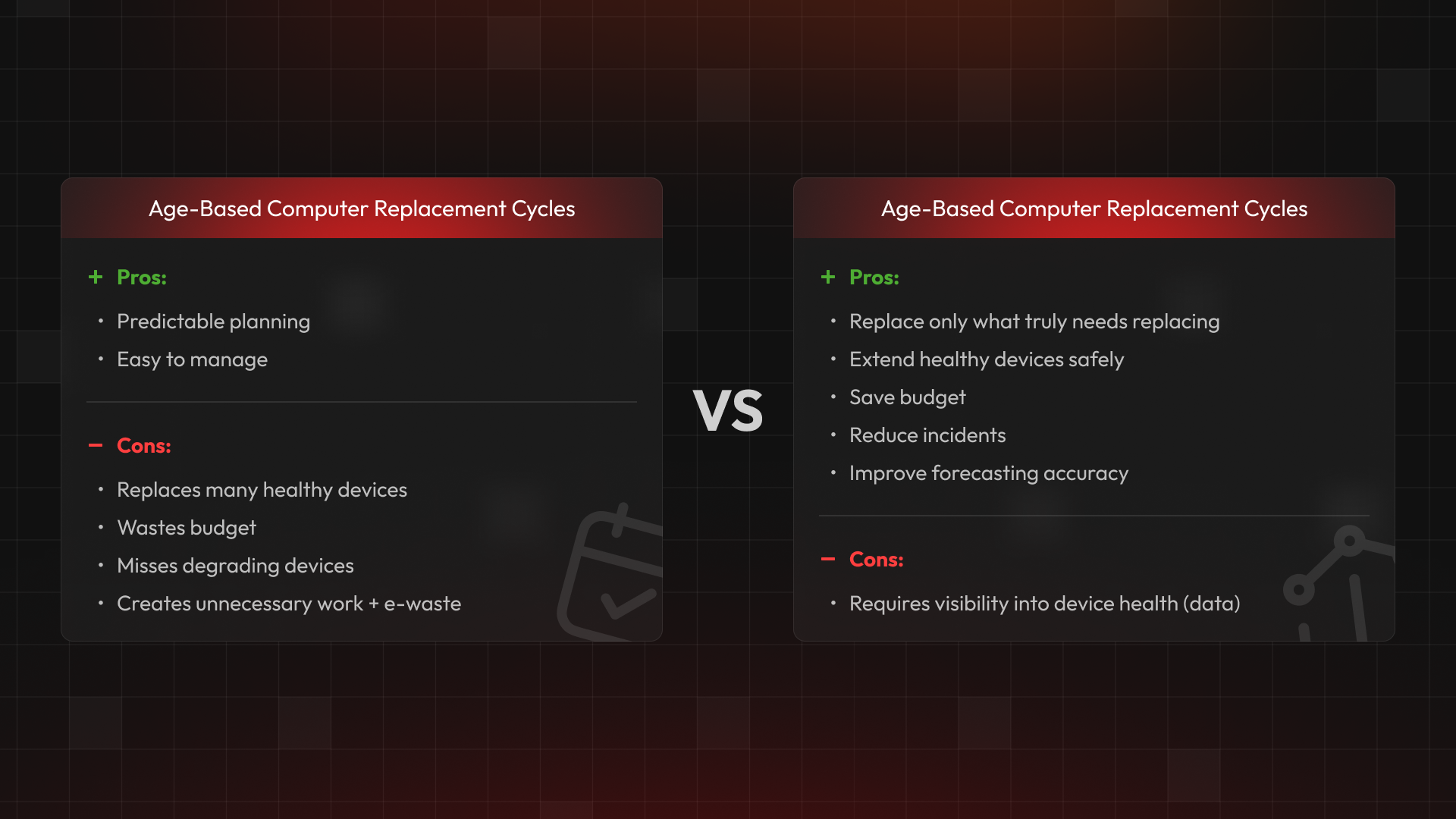
Considering Condition Is Not the Same as Operating It
In practice, most IT teams operate within one of three endpoint lifecycle models.
1. Age-Based Model
Some organizations rely primarily on age-based refresh cycles. Devices are replaced after a fixed number of years because the model is predictable, easy to plan, and simple to explain to finance and procurement.
2. Condition-Aware Model (Hybrid)
Others operate what is often described as a hybrid or condition-aware model. Age defines the baseline, but exceptions are made. Devices are extended when users are satisfied. Replacements happen earlier when performance issues surface.
Both approaches are reasonable. Both exist because IT teams know age alone is an imperfect proxy for device health.
However, in hybrid environments, condition-aware decisions are rarely formalized. They are triggered by events rather than continuously evaluated. A user complains. Performance degrades visibly. A ticket escalates. At that point, condition is assessed and a decision is made.
These decisions are typically:
- informal rather than defined,
- reactive rather than continuous,
- based on scattered signals rather than shared, decision-grade metrics.
Each decision may be sensible in isolation. Collectively, they produce inconsistent outcomes across the fleet.
3. Fully Operational Condition-Based Replacement System
A condition-based replacement system operates differently. Condition is not an exception mechanism; it is the primary decision framework.
Device health is continuously measured using defined, shared metrics. Replacement, extension, reallocation, and intervention decisions are made proactively, consistently, and at fleet scale. Age becomes a secondary input rather than the governing rule.
In this model, lifecycle decisions are:
- formally defined rather than implicit,
- continuously evaluated rather than event-driven,
- based on objective, decision-grade data rather than individual signals.
This is the difference between considering a computer condition and operating it as a system.
Computer Replacement Models Compared
|
Dimension |
Age-Based |
Condition-Aware (Hybrid) |
Condition-Based System |
|
Core trigger |
Device age |
Age + (scattered) signals |
Defined condition thresholds |
|
How degradation is understood |
Assumed linear |
Acknowledged as variable |
Modeled by usage & workload |
|
Financial waste |
High (premature replacements) |
Medium |
Low |
|
IT resources required |
Medium (unnecessary refresh work) |
High (manual review & exceptions) |
Low (automated decisions) |
|
Sustainability impact |
High waste (shortened lifespan) |
Medium |
Low (maximized useful life) |
|
Auditability |
High (simple rules) |
Low |
High (evidence-based) |
|
Scalability |
High |
Low |
High |
Why Waste Persists Even in Well-Run IT Organizations
This inconsistency is the root cause of waste. Some devices are replaced too early, while still delivering full value. Others are kept too long, even as performance, reliability, or security posture quietly degrades. Budget is spent, but not always where it meaningfully improves outcomes.
Importantly, this is not a failure of discipline. It is a consequence of operating lifecycle decisions without a repeatable decision model.
When a condition is not clearly defined, continuously evaluated, and applied consistently, it remains an input rather than a control mechanism. In that situation, inefficiency is guaranteed, even in mature IT organizations.
The waste is difficult to see because fleets appear modern and budgets remain stable. The real impact only becomes visible when spending is evaluated in terms of outcomes rather than timing.
The Real Cost Is Not Overspending, It Is Spending Without Impact
Consider a common, simplified scenario:
- 1.000 end-user devices
- Average device cost: €1.500
- Standard refresh cycle: 4 years
This results in approximately:
- 250 devices replaced per year
- €375.000 in annual endpoint hardware spend
Now, assume that only 60-70% of devices reaching year four actually show declining security posture, performance, or reliability. The remaining 30-40% are still fit for purpose.
That means:
- 75-100 devices per year are replaced without a clear technical or productivity need
- €112.500–€150.000 of annual spend does not materially improve outcomes
The money is spent. The fleet looks newer. But the replacement itself does not solve a problem.
Residual Value Leakage Is Easy to Miss
Prematurely replaced devices do not lose their value overnight. They are often resold, refurbished, redeployed internally, or reused by another organization.
If a device that originally cost €1.500 is removed one year early and later reused for €300–€500, the original organization has effectively funded most of the device’s productive lifespan, while another party captures the remaining value at a discount.
Across dozens or hundreds of devices per year, this creates a consistent pattern of residual value leakage, even though every individual decision felt reasonable at the time.
Productivity Loss Does Not Appear in Hardware Budgets
There is also waste on the opposite end of the spectrum. In the same 1.000-device environment, assume:
- 10-15% of devices degrade earlier than expected
- each generates just one additional support ticket per year
At an internal cost of €40-€60 per ticket, this results in:
- 100–150 additional tickets
- €4.000–€9.000 in direct IT effort
More significant is the productivity impact.
If 100 users lose only 10 minutes per week due to slow boots, instability, or recurring minor issues, that equates to:
- roughly 850 hours of lost work per year
- approximately €34.000 in productivity cost at €40/hour
None of this appears in endpoint hardware budgets. It is absorbed quietly across teams and time.
Predictability Masks Precision Problems
Age-based refresh cycles are trusted because they are predictable. Predictability simplifies planning and stabilizes budgets. But predictability alone does not guarantee quality.
In the example above:
- €375.000 is spent every year
- a meaningful share does not improve outcomes
- another share of problems persists longer than necessary
The organization is not overspending. It is spending imprecisely.
Capital is deployed where it has little effect, while genuinely degrading devices remain underfunded until issues become unavoidable.
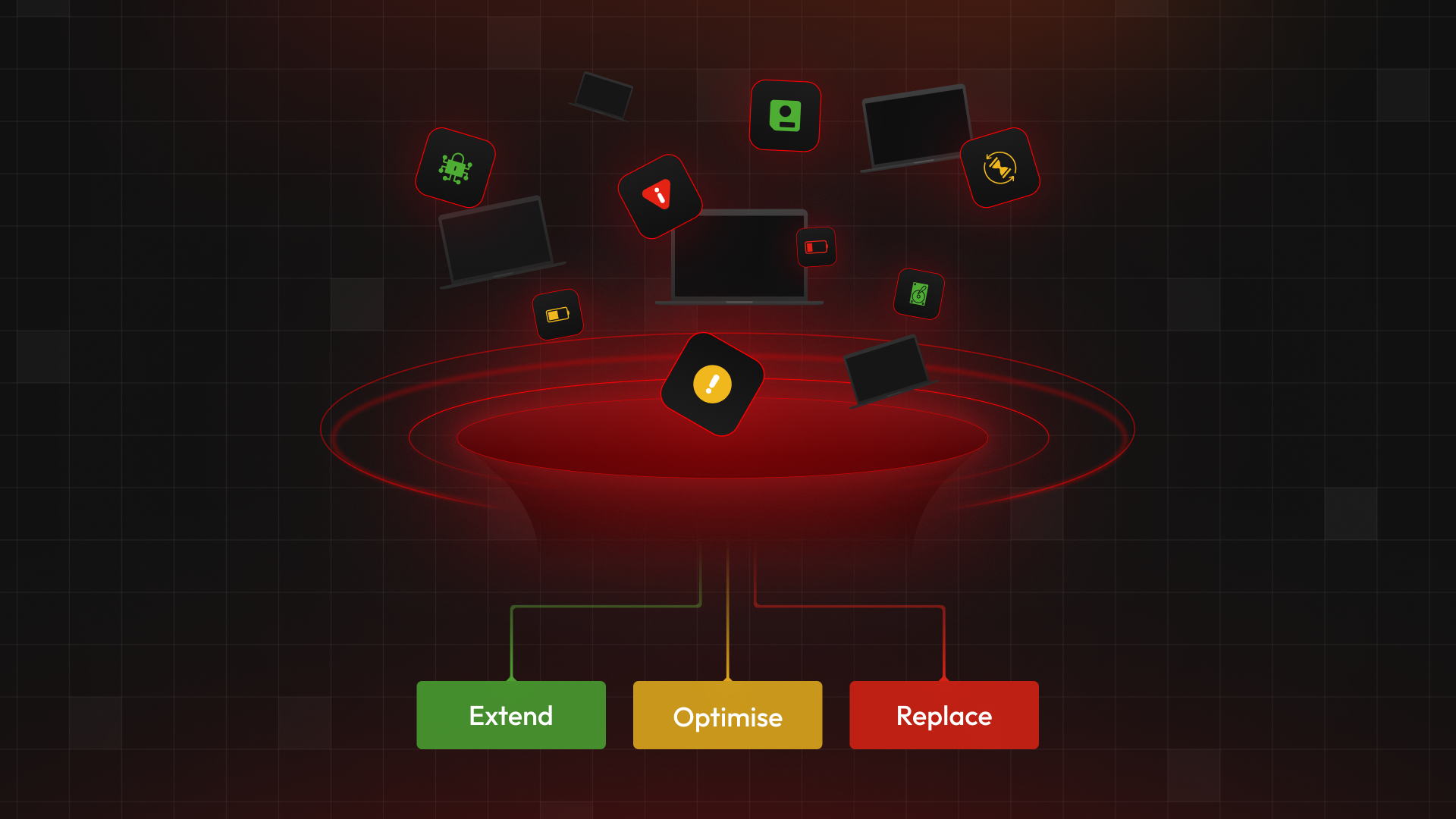
What Changes With an Operational Condition-Based System
The opportunity is not to reduce device spend at all costs. It is to reallocate spending toward actual needs. If even half of the prematurely replaced devices in the example were safely extended by one year:
- annual replacement volume drops by 40–50 devices
- €60.000-€75.000 of hardware spend is deferred
- unnecessary replacement work is reduced
- residual value is retained longer
At the same time, earlier intervention on genuinely degrading devices reduces:
- support load
- user frustration
- hidden productivity loss
Lifecycle management stops being about spending less. It becomes about ensuring that every replacement meaningfully improves security, performance, or reliability.
That level of precision cannot be achieved through intent alone. It requires a decision model that consistently distinguishes between devices that still deliver value and those that no longer do.
Want to calculate how much you can save with a condition-based replacement system? Check our Savings Calculator!
Why Operating the System Is the Real Shift
The critical distinction is not age-based versus condition-aware thinking. It is whether lifecycle decisions are operated as a system.
Without explicit metrics, defined thresholds, and continuous evaluation, the condition remains subjective and episodic. With them, lifecycle management becomes auditable, scalable, and outcome-driven.
That is the difference between knowing devices degrade by use and actually eliminating waste because of it.
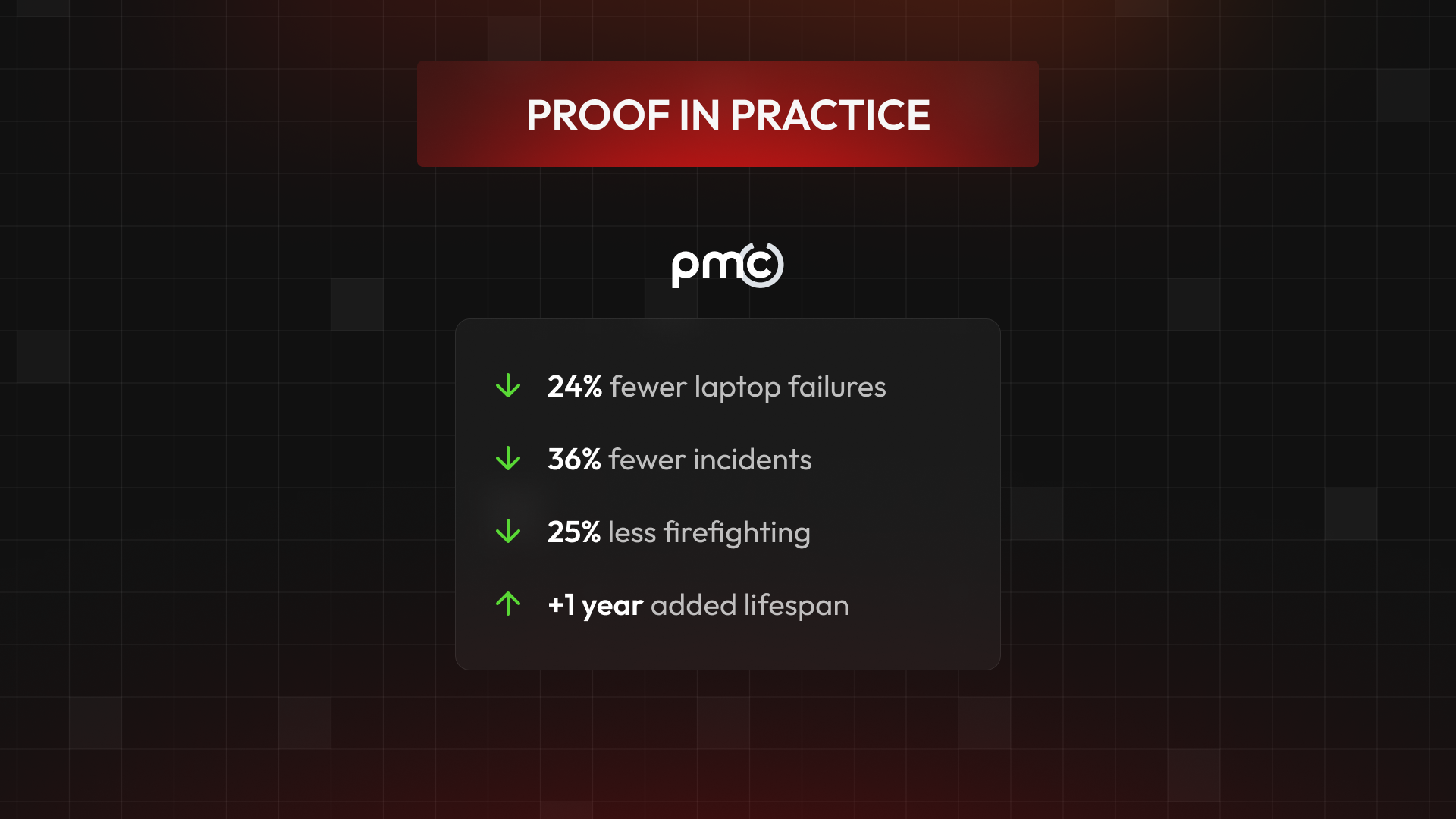
PMC’s Lifespan Policy Success Story
With a small team of around ten professionals, their goal was simple: keep operations smooth, users productive, and costs predictable. But without clear insight into device health, internal replacements and fixes were often based on assumptions rather than evidence.
The results were measurable:
- -24% fewer laptop failures
- -36% fewer overall incidents
- -25% less time spent on firefighting issues
- +1 full year added to average device lifespan
Instead of replacing computers on a schedule, the team now makes data-backed decisions, rebuilding, repairing, or refreshing only when truly needed.
As Senior IT Lead Matt Tombs explains:
“We can catch machines before they fail and fix what’s needed instead of replacing the whole device. It’s helped us make much better use of our existing hardware.”
Check out PMC's Lifespan Policy Success Story here!
Key Takeaway:
Extend When You Can, Replace When You Must.
Most IT teams aren’t struggling because of a lack of effort; they’re struggling because of limited unified visibility. Without real data on how computers perform, age, and fail, even the most experienced teams end up making reactive decisions.
Condition-based replacement system, powered by Applixure, changes that. It gives IT leaders the insight to see where they stand today and what’s coming next, before problems escalate or budgets spiral.
When you know the real condition of your fleet, you can:
- Replace only what truly needs replacing
- Extend device lifespans through rebuilds, component swaps, or optimization
- Forecast IT budgets with confidence, backed by data instead of guesswork
- Prove value to Finance with measurable savings and predictable planning
The outcome isn’t just cost reduction, it’s control. A clear, evidence-based view of your computer fleet means fewer disruptions, smarter replacements, and more time for IT to focus on long-term improvement.
Download the Guide:
Replace Computers by Condition, Not by Calendar
This guide explains how to move from an age-based to a condition-based replacement policy, where decisions are based on real device health and user impact instead of fixed timelines.
It shows how IT teams can safely extend the lifespan of healthy computers, reduce premature replacements, and regain control over hardware spend, without adding operational complexity. Download the Guide here.
Book a Lifespan Analysis Explainer with Applixure
Book a Lifespan Analysis Explainer Session with Applixure to understand the real condition of your endpoint fleet and where action is actually required.
In this session, we walk through how a lifespan analysis works, what inputs it uses, what outputs it produces, and how it helps identify which devices would require intervention and which could safely remain in service.
Book Lifespan Analysis Explainer here.
Stay Ahead in IT
Get monthly insights and guides for smarter IT management
No spam. Unsubscribe anytime.