
In this article
Share with your community!


Edited & Reviewed
 Edited & Reviewed
Reading time 3 mins
Updated on November 16, 2026
In this article
Share with your community!
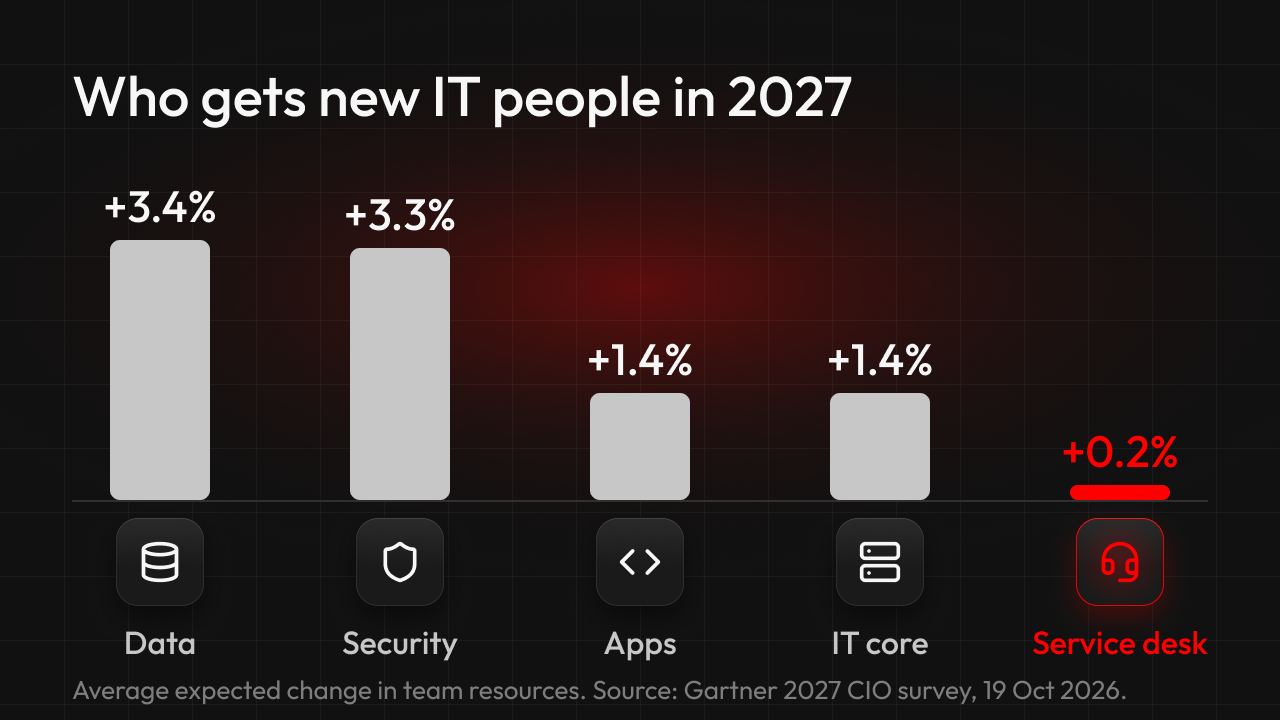
Gartner's survey of 2,002 CIOs expects IT headcount to grow in 2027, but not evenly: data and analytics +3.4%, cybersecurity +3.3%, and infrastructure, operations and service desk just +0.2%. Almost a quarter of CIOs expect that last team to shrink.
If your end-user team isn't growing, the extra capacity has to come from less work: fewer tickets and fewer unnecessary replacements.
What do CIOs expect for IT headcount in 2027?
Growth, but not in the team that keeps laptops running.
- Gartner, 19 Oct 2026: 40% of CIOs expect IT headcount to grow in 2027, mainly in cybersecurity and data and analytics. Gartner 2027 CIO and Technology Executive Agenda survey
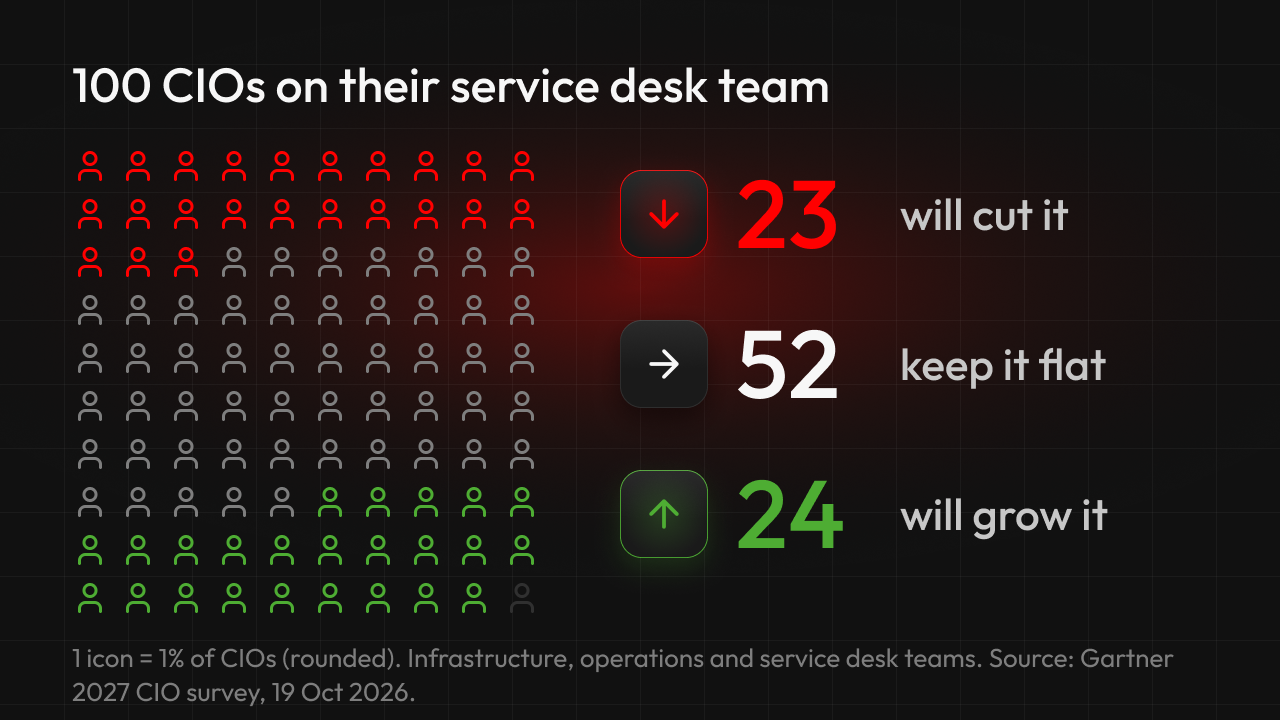
- By team: expected average change is +3.4% for data and analytics and +3.3% for cybersecurity, but only +0.2% for infrastructure, operations and service desk. 23% of CIOs expect that team to shrink. Source
- Budgets still rise: 50% of CIOs plan to increase digital workplace funding in 2027, by 12% on average. Source
What does this mean for your end-user team?
More workplace tech to run, with the same people.
- Plan as flat: +0.2% of a ten-person team is 0.02 of a person.
- Headcount requests compete with security and data: that is where CIOs are putting new roles.
- The workload doesn't wait: a reactive team spends its time on tickets, and preventive work stops.
What are your options?
You have three. Only one adds capacity without a new hire.
- Option 1: Ask for headcount anyway. The request competes with security and data, and it's a hard sell in 2027.
- Option 2: Absorb the work. The team stays reactive, the backlog grows, and preventive work stops.
- Option 3: Reduce the work. (Recommended) Fix problems before users report them, keep the environment healthy, solve recurring issues once, and replace only the devices that need it. All of these actions win back time.
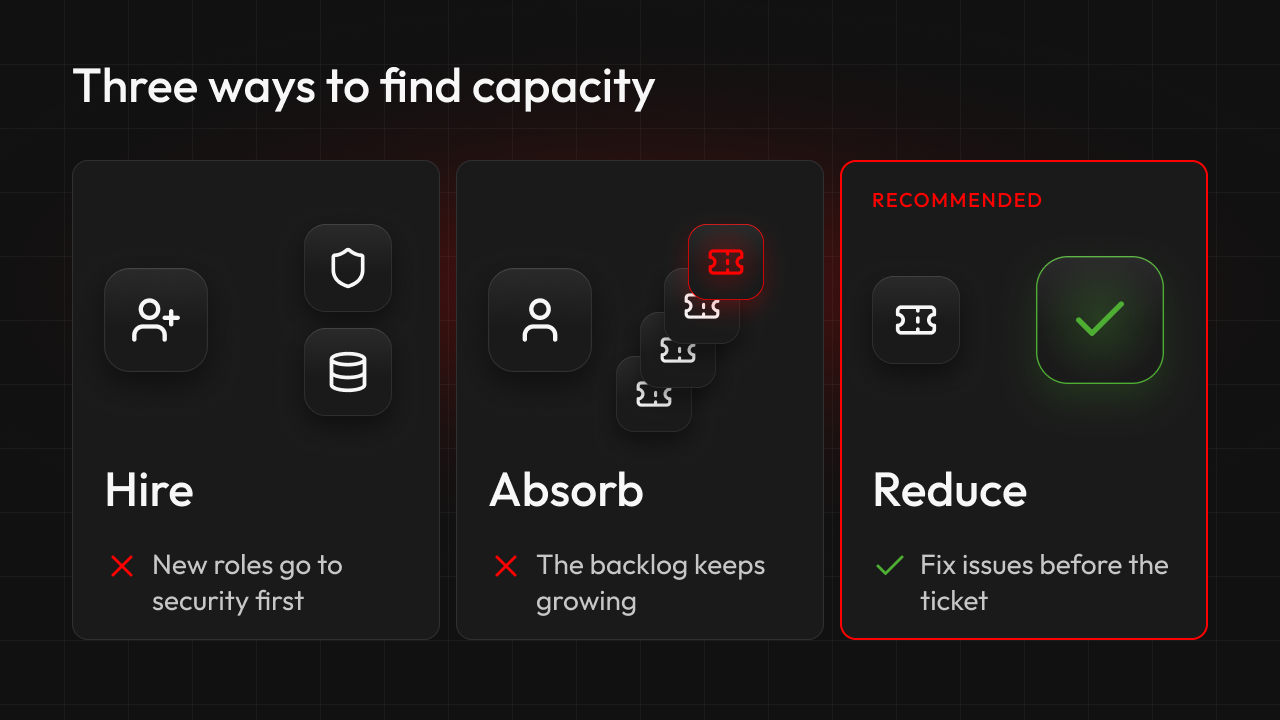
Too many IT teams still wait for someone to report an issue, even when their data could show the problem earlier.
- Without fleet health monitoring, issues come out of nowhere: nobody tracks the health of the computer fleet, so the team only hears about problems when users report them.
- With quality management, you see them coming: the team sees the health of the computer fleet and fixes things on its own schedule, with its own resources, before they disrupt users.
- The payoff is predictability: time goes to the priorities that matter most, not the loudest unexpected issue of the day.

How do you reduce IT support tickets without hiring?
Measure, fix early, and replace only what must go.
- Monitor the health of your fleet. Applixure Analytics tracks the health of your environment.
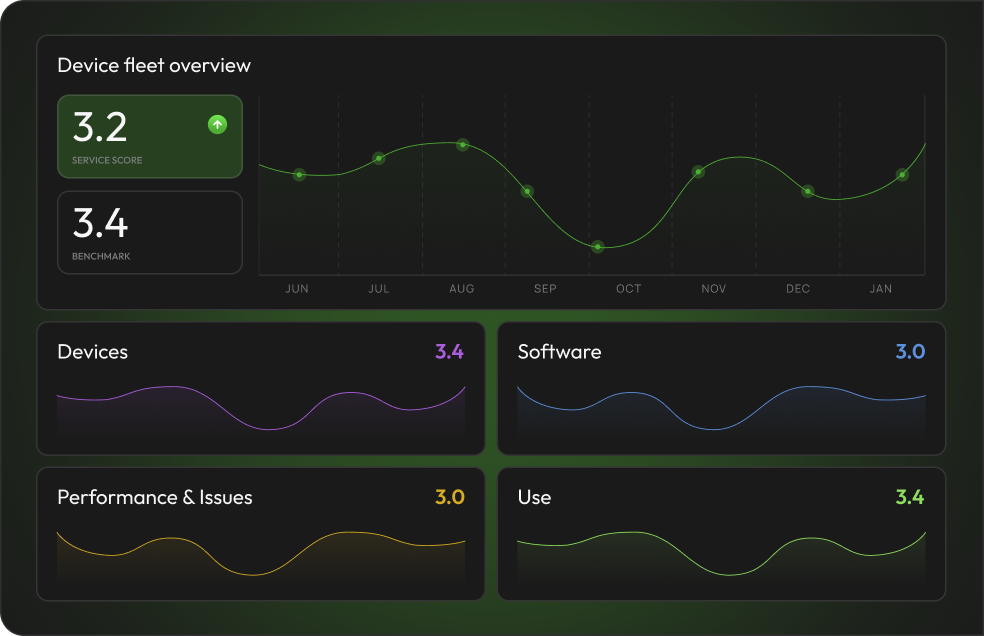
- Spot problems early. Find devices whose performance is degrading before users raise tickets, so you have a clear overview of the health and issues in your environment.
- Set minimum quality standards. Define thresholds for boot time, crashes, disk space, memory, and battery wear, and track what share of the fleet meets them.
- Route fixes automatically. Applixure Workflow monitors those thresholds and sends alerts to your ticketing tool when a device falls below your health standards. Applixure integrates with ServiceNow and Efecte, and has an open API.
- Raise the bar. Over time, improve the quality standard you set for your environment.
- Bonus: Replace only what must go. After about a month of data, Lifespan Analysis recommends extend, fix or replace for every computer (here's how it works in 30 days). It matters more now that PC prices won't drop in 2027.
Want to see it on a real fleet? Book a meeting.
How do you show leadership it's working?
Show three things: proof it works, proof it scales and the money.
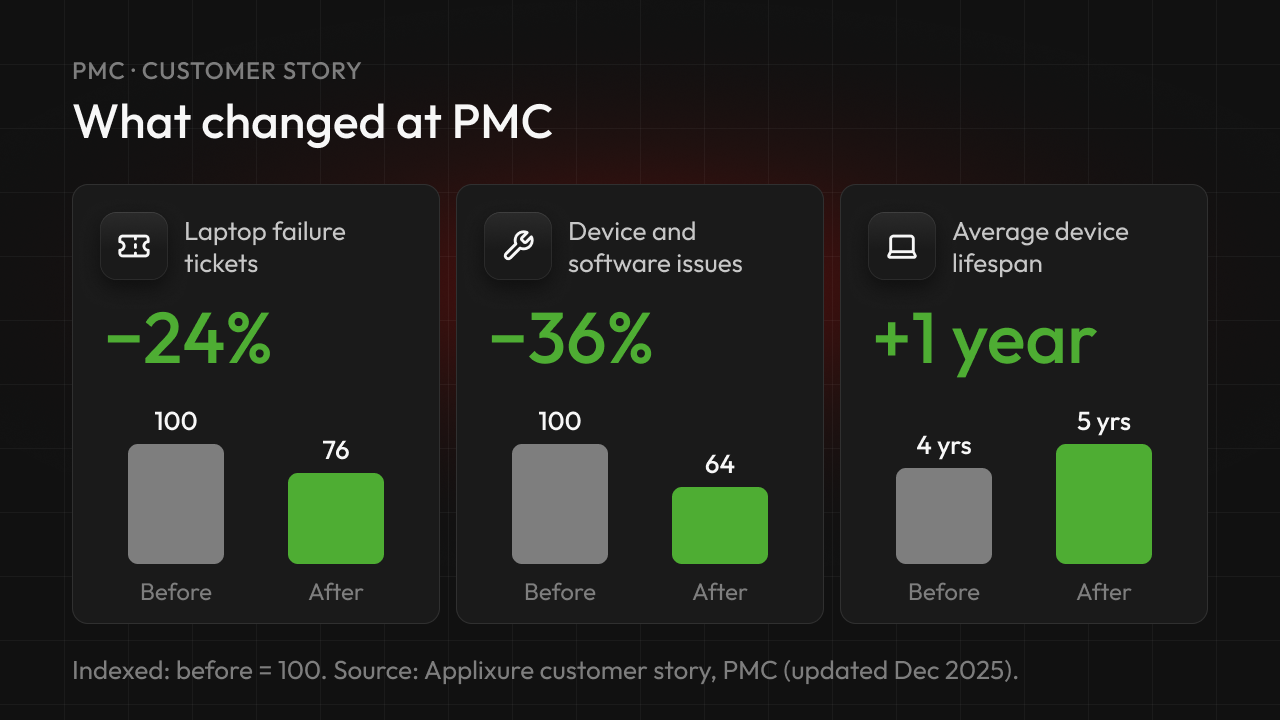
- Proof: at PMC, an IT team of about ten people saw 24% fewer tickets from laptop failures and 36% fewer device and software issues. They spend 20–25% less time firefighting, and average device lifespan went from four to five years.
- Scale: JYSK supports 10,000 devices across 1,500 stores without growing IT headcount.
- Money: report the hours you've reclaimed next to the replacements you've avoided. Run your own numbers in the Savings Calculator.
FAQ
Will IT headcount grow in 2027?
For 40% of CIOs, yes, but mostly in security and data. Infrastructure, operations and service desk teams average +0.2%, so plan your end-user team as flat.
How can IT teams reduce support tickets without hiring?
Find degrading devices before users report them, fix recurring causes once and send alerts straight into your ticketing tool. Avoiding unnecessary replacements frees up more time on top of that.
What tools can detect failing computers before users raise tickets?
Digital employee experience (DEX) tools such as Applixure Analytics track device health (boot time, crashes, disk space, memory and battery wear) and flag degrading computers early. Applixure Workflow then sends alerts to your ticketing tool when a device falls below your health standards.
How much IT time does a computer replacement take?
PMC estimates about half a day per device, covering setup, data transfer and coordination with the user. At 200 replacements a year, that's about 100 working days.
Does keeping computers longer create more support work?
Not if you replace by condition rather than age. PMC extended lifespans from four to five years, and tickets from laptop failures still fell by 24%.
Book a meeting
Your 2027 plan can still change. Book a meeting with Applixure: we'll show you where your end-user team's time goes today, and how much fewer tickets and fewer replacements could free up.
Prefer to read first? Download the Key Quality Metrics guide.
Stay Ahead in IT
Get monthly insights and guides for smarter IT management
No spam. Unsubscribe anytime.